


.png)
By Teasha Cable, CEO & Co-Founder, CModel Data, Inc.
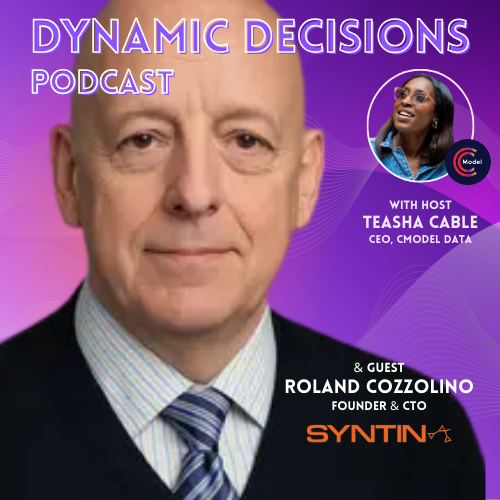
Roland Cozzolino, CTO and Founder at Syntin, discovered this unsettling truth in the early 2000s. He'd built something remarkable during the Web 2.0 era: an AI system so accurate at predicting user preferences that it could anticipate what websites you'd want to visit before you even thought about them.
Open your browser, and boom—perfectly curated content waiting for you. People freaked out.
"I was so accurate that I scared people"
The technology could dissect your preferences with uncomfortable precision, revealing what you liked, what you didn't, and what you'd want to see next. In an era just waking up to privacy concerns, that level of predictive power felt invasive, even creepy.
So Cozzolino pivoted. He took his talents to the advertising world, founding MediaMath as CTO, where personalized targeting felt less threatening in a commercial context. But that early experience shaped everything that came after—particularly his current venture, Syntin, where he serves as CTO and founder.
Cozzolino's path into AI wasn't traditional. Despite coding since age seven or eight, he graduated college with a math degree and never enrolled in a single computer science class.
"I couldn't stop. And I never did."
His career became a masterclass in pattern recognition across industries. He worked in high-frequency trading, watching algorithms make split-second financial decisions. He built software compliance systems at Compliance Group. Each experience added another layer to his understanding of how decisions actually work—not just how we talk about them, but how systems execute them autonomously.
At MediaMath Cozzolino personally visited every major advertising exchange: Google, Yahoo, Rubicon, Pubmatic. He asked for "full pipe"—complete data streams—and then watched as executives balk. Yahoo thought he was crazy. Google questioned whether he could handle that volume.
"I got one machine."
He built the mathematics behind real-time bidding for advertising, creating a marketplace that previously didn't exist. By applying high-frequency trading concepts to ad tech, Cozzolino helped transform how digital advertising operates today.
His approach diverges from the current AI hype cycle. While the tech world obsesses over large language models (LLMs) like ChatGPT, his focus remains laser-locked on something fundamentally different: autonomous decision-making.
"My AI is not about large language models. It's about decision-making."
He offers a simple thought experiment: Imagine you're in a car approaching an intersection where you can only turn left or right. The vehicle should automatically know these are your only options. That's a decision—one that doesn't require you to ask the car which way to go. No conversation.
No prompt engineering. Just intelligent, context-aware action. This reasoning-based approach addresses a critical gap in today's AI landscape.
LLMs excel at generating human-like text and responding to queries. They're conversational partners, creative assistants, and information synthesizers. But they fundamentally operate through dialogue—you ask, they answer.
Cozzolino's vision centers on AI that acts independently, making operational decisions that improve business outcomes without constant human input. At Syntin, he's building systems that identify inefficiencies and automatically optimize processes.
Think less "chatbot" and more "autonomous efficiency engine."
The market desperately needs this distinction. Organizations are drowning in AI tools that require elaborate prompting and constant supervision. Meanwhile, their actual business processes—inventory management, resource allocation, workflow optimization—remain stubbornly manual.
That early experience of being "too accurate" taught Cozzolino a crucial lesson: technological capability must align with human readiness. You can build something that works perfectly and still fail if people aren't prepared for what it reveals or how it changes their world.
Technological capability must align with human readiness.
This wisdom informs how he approaches AI development today. It's not enough to make better predictions or faster decisions. The technology must integrate into existing business workflows in ways people can trust and understand.
Transparency matters. Explainability matters. Giving humans meaningful control matters—even when the AI could theoretically operate alone.
The polarization in today's AI market—between foundation model providers promising universal solutions and niche vendors offering pinpoint applications—misses something essential. Both approaches often overlook the fundamental question: What decisions does this business actually need to make better, and can AI make them autonomously?
Cozzolino's two-decade journey spans compliance software, advertising technology, high-frequency trading, and AI development. Through all of it, one thread remains constant: using mathematics and systems thinking to help organizations make better decisions faster.
Sometimes that means building something so accurate it's scary.
Other times it means recognizing that the real innovation isn't in conversational AI but in systems that quietly optimize behind the scenes.
The future of AI might not be about asking better questions. It might be about building systems smart enough that we don't need to ask at all. 🎯
For businesses navigating the crowded AI landscape, Cozzolino's perspective offers clarity: Don't chase the latest language model or the flashiest demo. Ask instead what decisions your organization makes repeatedly, where inefficiencies hide, and how autonomous systems could genuinely improve outcomes.
That's where the real transformation happens—not in the conversation, but in the execution.
Listen to our #DynamicDecisionsPodcast conversation:
Interested in learning more about innovative business models and decision intelligence? Subscribe to our blog for insights on how forward-thinking leaders are reshaping industries and driving collaborative innovation.
#ArtificialIntelligence #DecisionMaking #AIStrategy #MachineLearning #BusinessAutomation #TechInnovation #AILeadership #DigitalTransformation


